

A Hold and Win feature normally locks qualifying symbols on a separate grid while empty positions respin. A new qualifying symbol may lock and reset the respin counter; the round ends when the counter expires or another stated end condition is met. Exact trigger counts, starting respins, symbol values and jackpot rules vary, so the game help screen controls.
Editorial review: Checked by the Vegas11 editorial team. Updated August 8, 2026. Sources and game or account rules can change; verify the current screen before acting.
Risk reminder: Gambling outcomes are uncertain. No feature, statistic, promotion or account tool guarantees a return or prevents loss. Use only money you can fully afford to lose, follow local law and age rules, and stop when the planned limit is reached.
Key Takeaways
- Locked symbols usually remain until the feature ends.
- A new qualifying symbol may reset the respin counter.
- Filling the grid does not have one universal prize rule.
- Visible coin or jackpot labels must be read with the paytable and active stake.
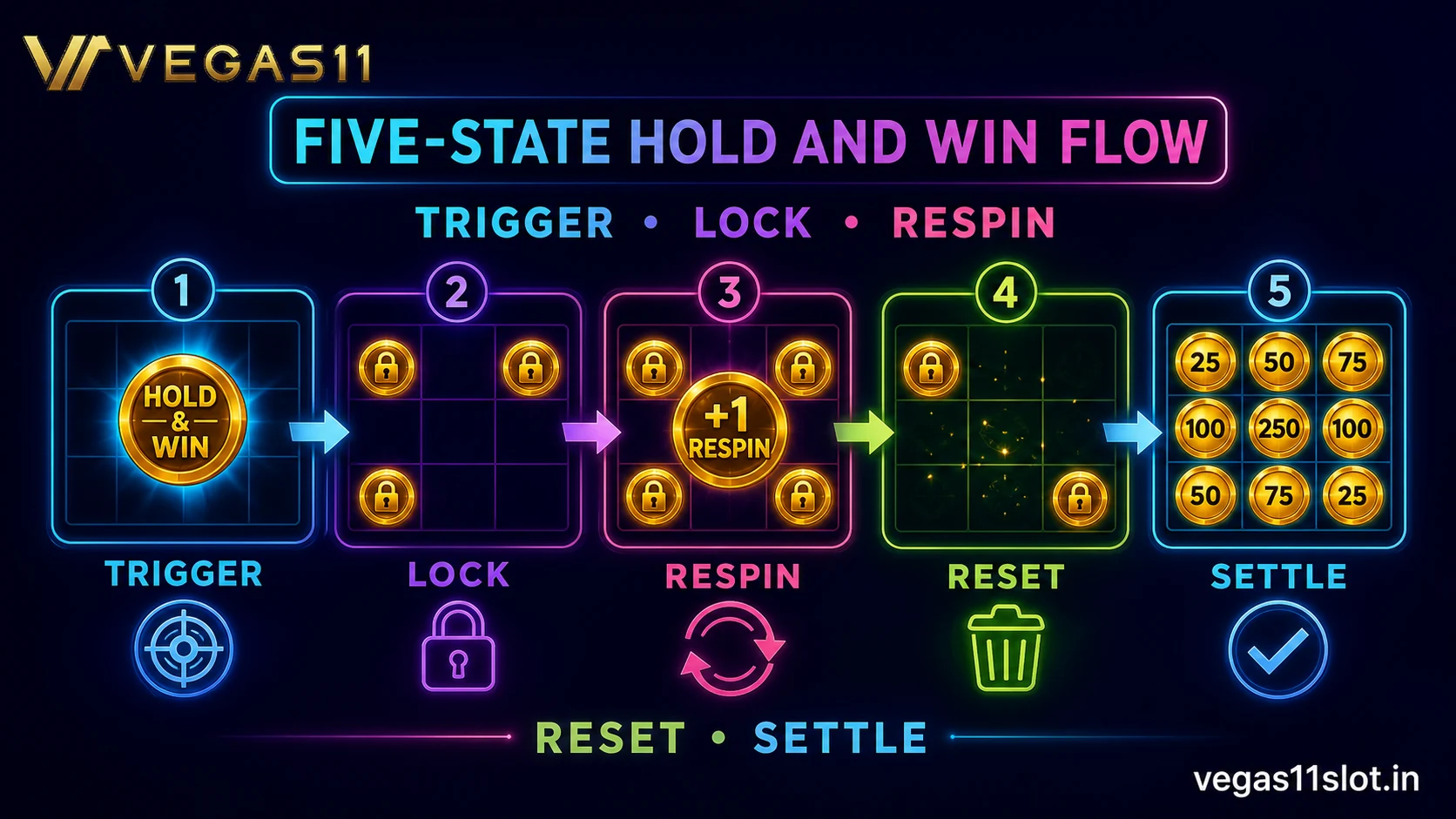
Read the feature as five separate states
The base game first checks whether the required trigger symbols have landed. If the condition is met, the feature moves to a lock state: qualifying symbols stay in position while other spaces become available for respins. The game then cycles through respin and counter checks until the stated ending rule is reached.
Thinking in states prevents a common mistake. The animation may make the feature feel like it is building momentum, but the rules are mechanical. The next symbol is not owed because the grid is nearly full. What matters is the current counter, the remaining empty positions and the random outcome of the next respin.
- Trigger: required symbols appear.
- Lock: qualifying values remain.
- Respin: empty positions update.
- Reset or expire: counter changes.
- Total: the rules settle collected values.
| State | What happens | What to verify |
|---|---|---|
| Trigger | Required symbols activate feature | Count and symbol type |
| Lock | Qualifying symbols remain | Which positions and values stay |
| Respin | Empty positions update | Starting counter and eligible symbols |
| Reset/expire | Counter restarts or falls | Exact reset condition |
| Settlement | Collected values are totalled | Modifiers and jackpot rules |
The respin counter needs careful attention
Many Hold and Win games begin with a small number of respins. When a new qualifying symbol lands, the counter may return to its starting value. A blank respin usually reduces the counter. The feature ends after the permitted sequence of blank results, not after a fixed number of total animations.
Do not assume every game starts at three or resets in the same way. Some variants add extra positions, collect symbols, multipliers or special modifiers. Check the help screen before play and again after a version update. A familiar visual theme does not prove that two games use identical maths.
- Note the starting counter.
- Identify what qualifies as a reset.
- Check whether special symbols alter the grid.
- Confirm the exact end condition.
Coin values and jackpot labels can work differently
A locked symbol may display a cash value, a multiplier of the active stake or a named prize. The display should explain whether the value is fixed, stake-relative or determined by another rule. Changing the stake before triggering can change displayed values in some games, but it does not make a feature trigger certain.
Named Mini, Minor, Major or Grand labels can be fixed, progressive or feature-specific. A full grid may award one of them in some titles and not in others. Never transfer the rule from a review or another game. Use the paytable for the exact version and save the round ID if the settled amount is unclear.
- Is the value cash or a stake multiplier?
- Is the jackpot fixed or progressive?
- Does a full grid award a named prize?
- Are modifiers added before or after the total?
| Respin | New symbol? | Counter after result | Note |
|---|---|---|---|
| Start | Trigger symbols | 3 | Opening grid |
| 1 | Yes | 3 | New value locks |
| 2 | No | 2 | No reset |
| 3 | No | 1 | One remaining |
| 4 | No | 0 | Feature settles |
Use a counter ledger during demo review
In demo mode, pause after each respin and record the counter before the result, any new locked symbol and the counter after the result. This small ledger makes the reset rule visible. It can also show whether a special symbol changes more than one part of the grid.
The exercise is for understanding, not prediction. A demo history does not reveal when a paid feature will trigger or what it will return. Its value is operational: the player learns where the counter appears, how the total is displayed and where to find the completed round in game history.
- Counter before respin.
- New qualifying symbols.
- Counter after respin.
- Running displayed total.
- Final settled amount and round ID.
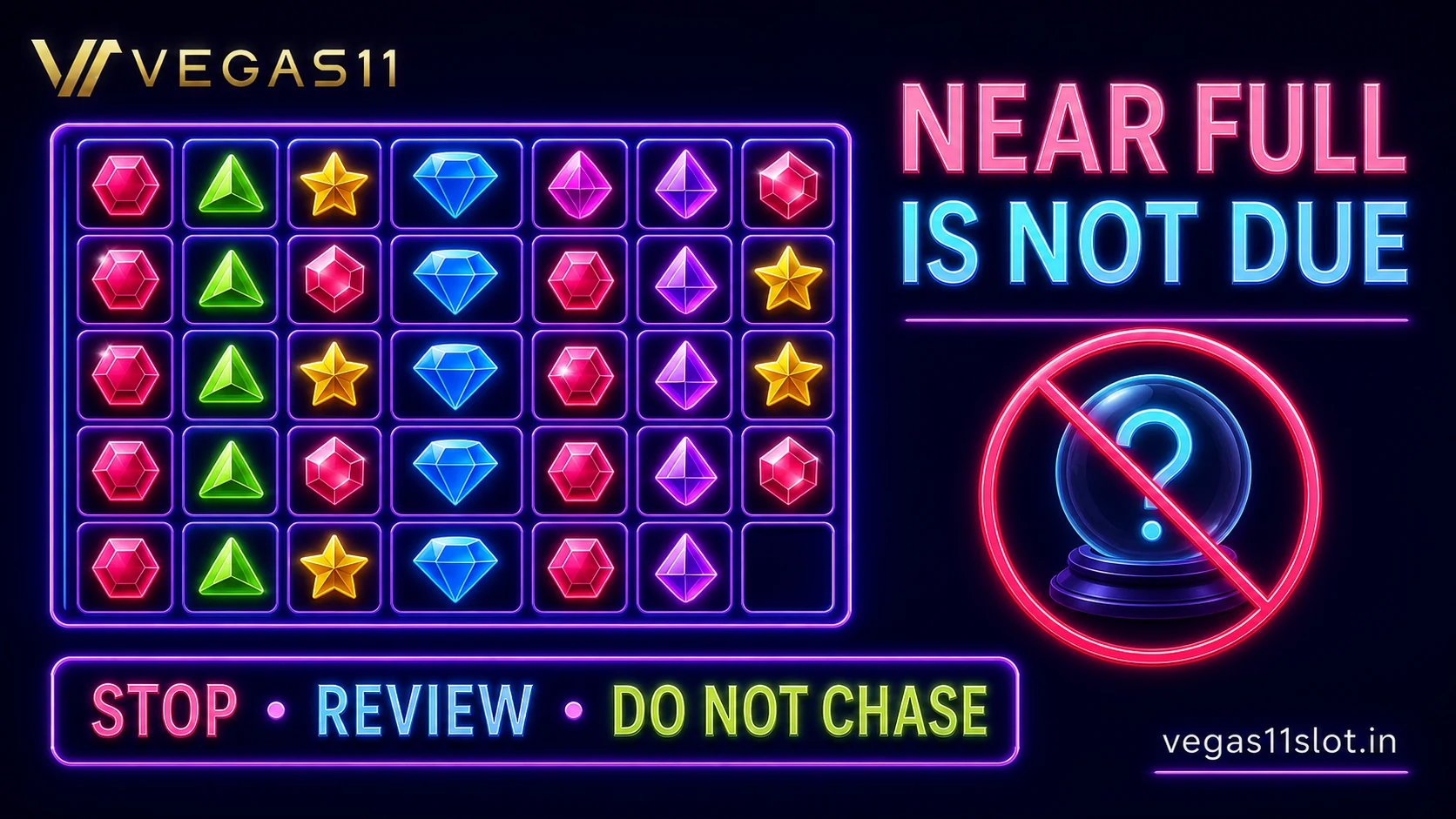
Why a nearly full grid is emotionally difficult
A grid with one or two empty spaces creates a powerful near-completion feeling. That visual pressure can encourage a player to buy another feature, raise the stake or extend the session. The remaining space is not a promise, and the next feature is independent of the one that nearly filled.
Choose the session limit before the feature begins. When the feature ends, wait for the balance and history to update, then decide whether the planned session is already complete. Do not use the near miss as a reason to chase another attempt.
- Treat every completed feature as final.
- Do not chase a nearly full grid.
- Review the net session balance after settlement.
- Keep feature-buy decisions inside a pre-set budget or skip them.
The best test is whether you can explain settlement
A readable Hold and Win game should let the player identify each collected value, any modifiers and the final total. If the result only flashes briefly, use game history. If the history entry does not explain the settlement or the support path is unclear, pause before further paid play.
The goal is not to memorise every branded variation. It is to ask the same questions: what triggered, what locked, what reset the counter, what ended the feature and how the total was calculated. A game that answers those questions is easier to monitor responsibly.
- I can identify the trigger.
- I can follow the reset rule.
- I can explain collected values.
- I can find the settled result later.
Reader scenario: one empty space remains
The grid reaches all but one position, and the final respin lands blank. The player feels that the missing symbol should arrive next time. The rule does not carry unfinished progress into the next trigger unless the game explicitly says so.
Record the final total, close the feature and compare the session with the pre-set limit. A near-complete grid is a visual outcome, not evidence that another paid attempt has improved odds.
Hold and Win rule check
- I know the trigger count and qualifying symbol.
- I know the starting counter and reset rule.
- I checked whether values scale with stake.
- I know what a full grid and each jackpot label actually award.
FAQ
Are Hold and Win and Hold and Spin the same?
They often describe a similar lock-and-respin structure, but branded rules can differ. Check the exact paytable.
Does every new coin reset the counter?
Often, but not universally. The help screen defines which symbols reset or modify respins.
Is the top jackpot automatic on a full grid?
No. Many games use that rule, but others use different awards or conditions. Verify the specific game.
Source and Update Note
This article was checked on July 14, 2026 for the search intent “hold and win slots explained”. It uses the sources below as general evidence. Game rules, promotion terms, app settings, account tools and support procedures can change by operator, version and jurisdiction. Verify the current page or help screen before making a money, privacy or account decision.
- BGaming Hold & Win mechanics — Same-intent benchmark reviewed July 14, 2026.
- Atlantic Lottery Diamond Multiplier Respin rules — Example showing that respin rules are game-specific.
Related Reading
- Slot Bonus Buy Feature Checklist: What to Review First
- Wild Symbols and Scatter Symbols: Slot Icons Explained
- How to Read Slot Paytables Before You Play
- Online Casino Session Budget Plan: Limits Before You Play
Check Vegas11 Details
Review the official sign-in page and current terms, and keep every session within your personal budget and time limits.