

Six Banker results in a column can look like a signal: follow the run, or bet that Player is due. A baccarat scoreboard supports neither conclusion by itself. It records completed hands. Read its legend to understand the display, and keep any stake decision separate from the shape of the road.
There is one detail worth getting right from the start. In a live game dealt from a finite shoe, cards are removed as play continues, so it is too broad to say every hand has exactly the same probabilities. That does not turn a coloured outcome chart into a dependable forecast. If a pattern is making you raise a stake or extend a session, stop following it.
Three displays, three different meanings
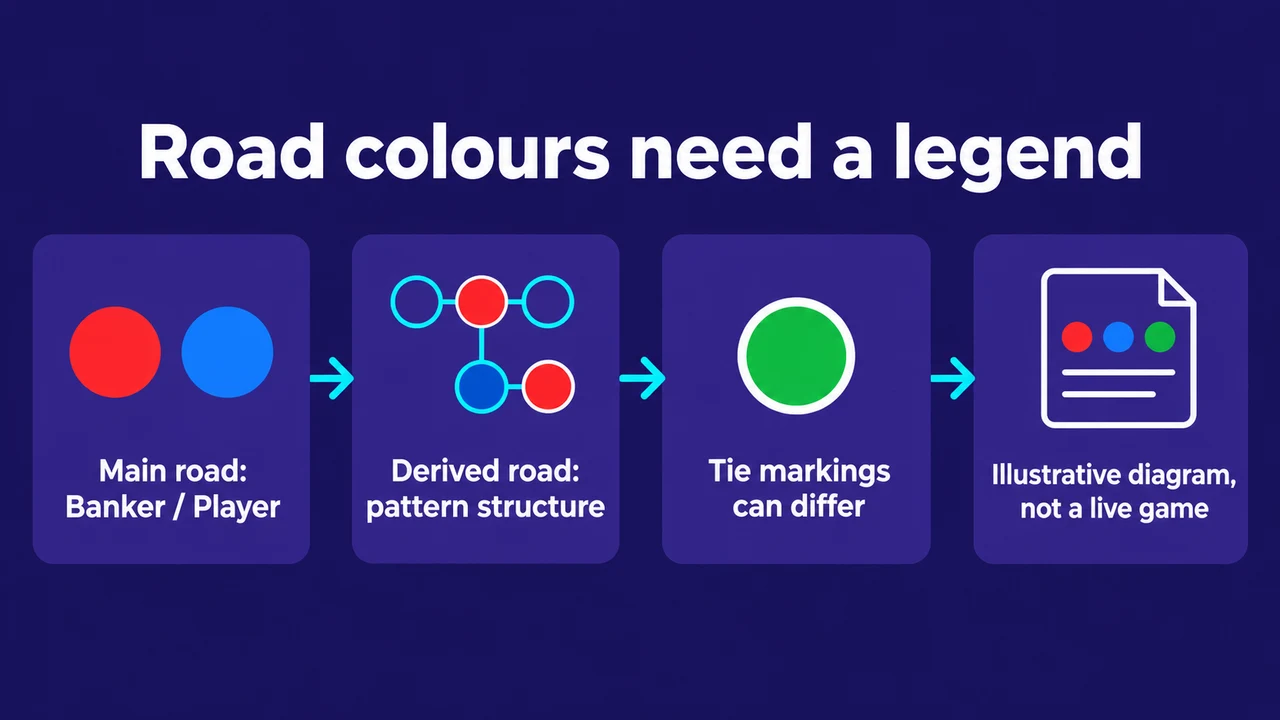
| Display | What it shows | Common reading mistake |
|---|---|---|
| Bead Road / Bead Plate | Completed results in chronological order | Reading a column as a recommendation |
| Big Road | A rearrangement that makes runs easier to see | Treating a long column as a continuing advantage |
| Derived roads | Patterns calculated from Big Road structure | Assuming red always means Banker and blue always means Player |
The important distinction is between an outcome colour and a derived-road colour. On a main results road, red and blue commonly identify Banker and Player. On a derived road, those colours can describe regularity or change in the displayed pattern instead. Check the actual table legend rather than transferring a meaning from another panel.
Ties also need attention. A Bead Road can give a tie its own cell, while a Big Road can mark it on the preceding result. Counting visible circles alone may therefore give the wrong number of completed hands. The table history is the better place to check an individual round.
Loto-Québec’s baccarat rule sheet explains this distinction and says road statistics clear when a new shoe is introduced. Its chart descriptions are useful documentation; promotional wording about prediction is not proof of a betting advantage.
A finite shoe is not a fresh coin flip
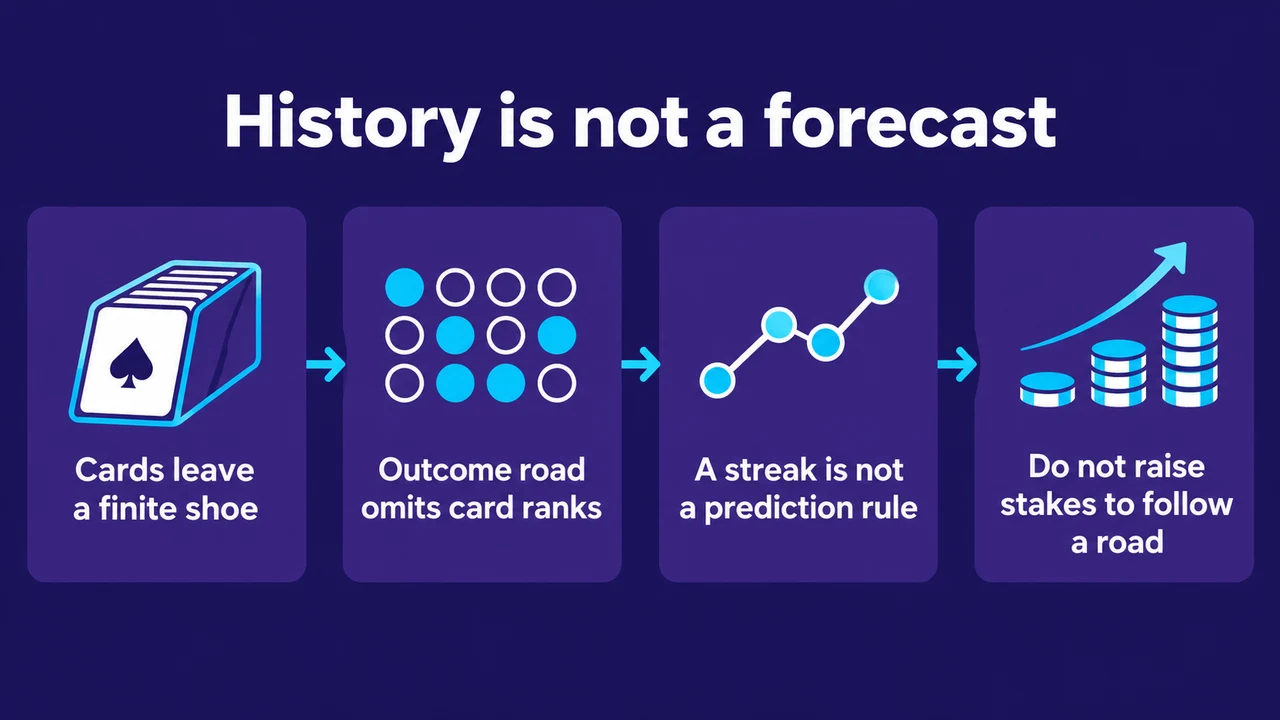
Imagine removing cards from a shoe without putting them back. The remaining composition changes. A full record of exposed card ranks contains different information from a list saying only Banker, Player or Tie. A road normally compresses the hand into an outcome; it does not preserve all the card information needed to assess the remaining shoe.
That is why two claims should be kept apart. “Cards leave the shoe” is a statement about the dealing process. “This red pattern tells us which side wins next” is a prediction claim that needs its own evidence. The first does not establish the second. RNG baccarat and live-dealer formats also need their own shuffle and dealing rules; do not assume a single reset procedure applies to both.
Nor does a previous imbalance create a debt the game must repay. A run can continue or stop, and neither outcome retrospectively proves that the road supplied a reliable signal. Calling a result after it happens is much easier than testing a rule on results it has not yet seen.
What would make a pattern claim worth checking?
A useful claim would have to specify the rule in advance: which road, which symbol sequence, which bet, and what happens on ties. It would then need a complete record of every qualifying event, including failures, under the same game rules. A screenshot selected after a good run supplies none of that. Changing the rule whenever it loses makes the claim impossible to evaluate.
- Use the legend to identify what each panel records.
- Check the shoe change and round history when reconciling results.
- Reject a claim that shows only its successful predictions.
- Do not increase the planned stake because a continuation or reversal feels certain.
Keep the scoreboard out of the recovery plan
A road can help you follow a broadcast or locate a past hand. It is not a reason to chase a loss. If following a pattern leads to doubling, the useful next reading is the cost of a baccarat Martingale progression, where the money committed is shown separately from the next stake.
For the wider rules-and-strategy question, see the baccarat strategy overview. For dealing mechanics, the third-card rule guide explains why a round may contain different numbers of cards. Neither a drawing chart nor a road promises the next winner.
Editorial update: October 2, 2026. This explanation uses published rule documentation and an editorial distinction between card information and outcome history. It is not a live-table test or an assessment of Vegas11 game availability. Gambling involves loss risk and is only for adults where lawful; leave the table when your time or spending boundary is reached.
This update was prepared with AI assistance and reviewed separately for clarity and source limits. It does not include a firsthand test of the platform.
Check Vegas11 Details
Review the official sign-in page and current terms, and keep every session within your personal budget and time limits.