

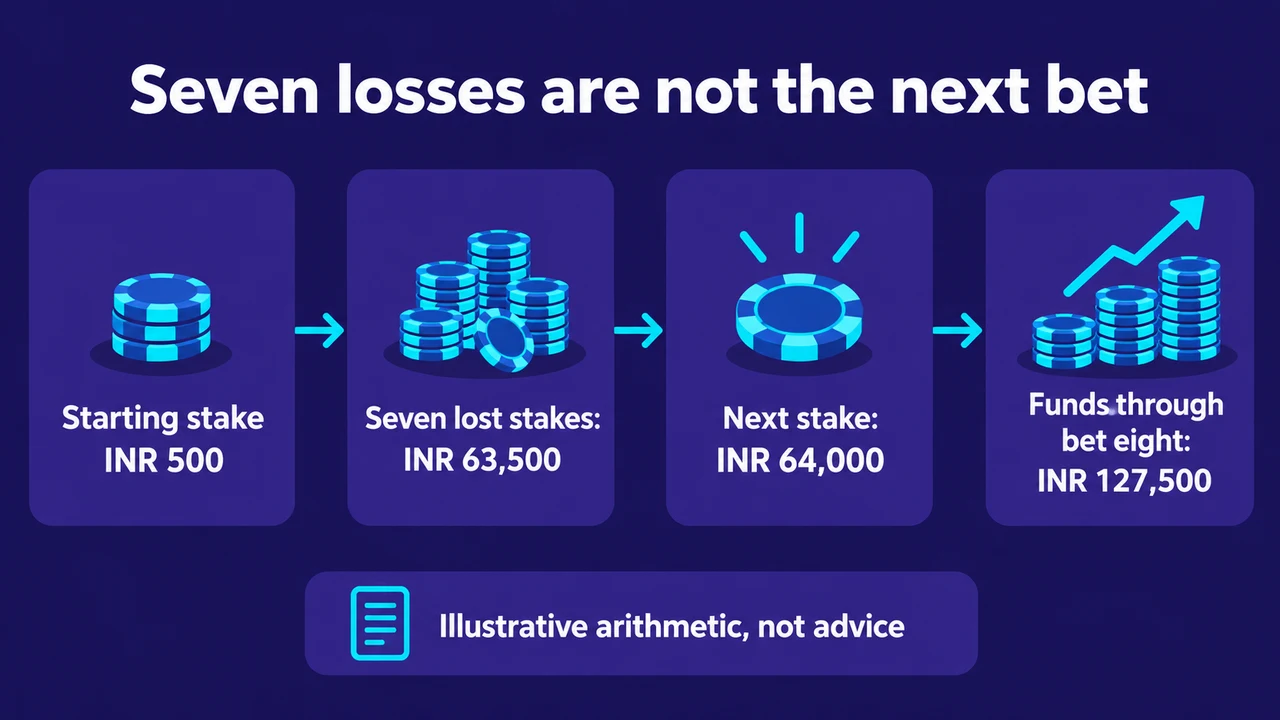
After seven lost bets starting at ₹500, a doubling sequence has already lost ₹63,500. The next bet would be ₹64,000—not ₹32,000. That gap between the last lost stake and the next required stake is where a simple Martingale explanation can become expensive.
This is a risk calculation, not a recommendation to continue. A Martingale raises the stake after a loss in the hope that one later win will repair the sequence. It cannot promise that the win arrives before your spending limit or the table maximum. If the next amount exceeds a limit you set beforehand, the sequence ends there.
The next bet is a new commitment
| Consecutive losses | Last lost stake | Total lost | Next doubled stake |
|---|---|---|---|
| 1 | ₹500 | ₹500 | ₹1,000 |
| 2 | ₹1,000 | ₹1,500 | ₹2,000 |
| 3 | ₹2,000 | ₹3,500 | ₹4,000 |
| 4 | ₹4,000 | ₹7,500 | ₹8,000 |
| 5 | ₹8,000 | ₹15,500 | ₹16,000 |
| 6 | ₹16,000 | ₹31,500 | ₹32,000 |
| 7 | ₹32,000 | ₹63,500 | ₹64,000 |
The table assumes seven resolved losing bets, no ties, and exact doubling. After n losses, the total lost is ₹500 × (2ⁿ − 1); the next stake is ₹500 × 2ⁿ. These are separate amounts. To have funded the seven losses and also place the eighth bet would require ₹127,500 in total available funds at the start, before any additional costs or restrictions.
That does not make ₹127,500 a sensible budget. It shows how much money the sequence demands to pursue a theoretical ₹500 cycle profit under an even-money payout. If that eighth bet loses too, the full ₹127,500 is gone and the following stake would be ₹128,000.
A Banker win does not pay the even-money example
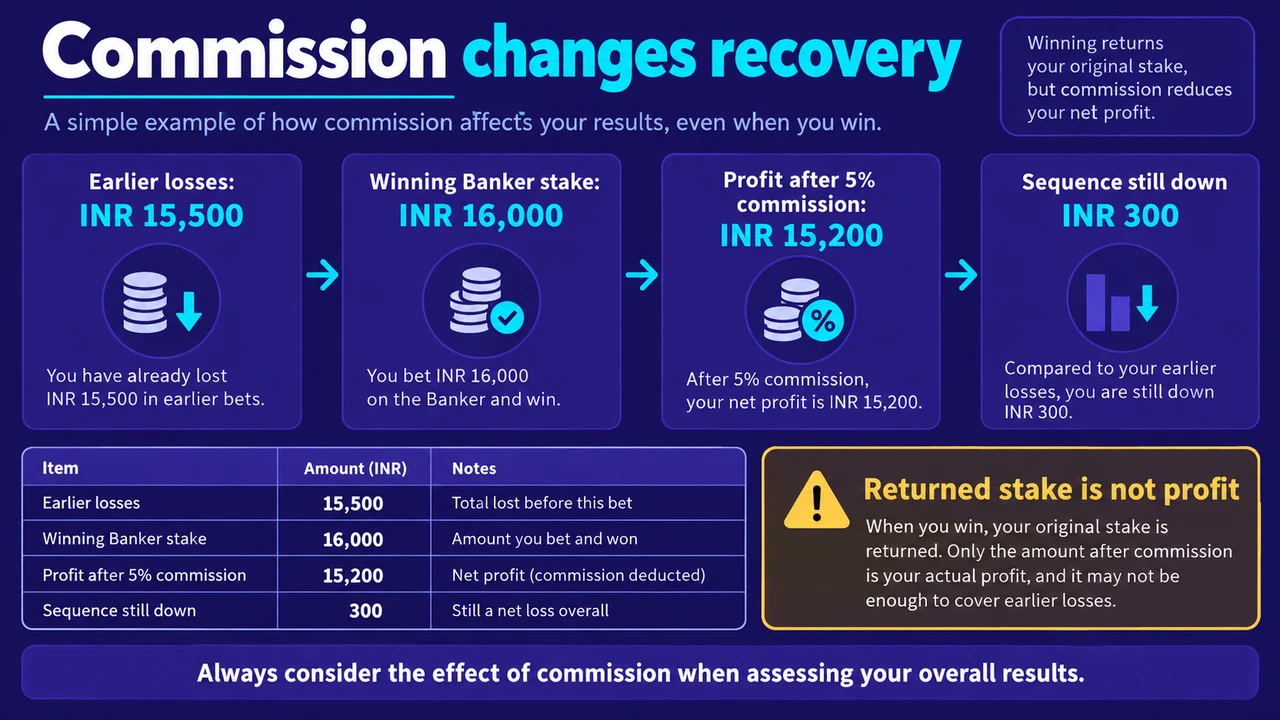
In the commission game documented by Loto-Québec, a winning Banker bet pays 0.95:1 after 5% commission. A ₹4,000 win therefore produces ₹3,800 profit. Subtract the ₹3,500 lost on the preceding ₹500, ₹1,000 and ₹2,000 bets: the sequence is up ₹300, not ₹500.
At a later step, simple doubling can fail to recover the losses at all. Five losses total ₹15,500. A winning ₹16,000 Banker stake produces ₹15,200 profit at 0.95:1, leaving the sequence down ₹300. The returned ₹16,000 stake is not profit and must not be counted a second time.
These examples assume exact 5% commission with no rounding. The selected table may use another settlement rule. Read Banker commission and no-commission payout examples before treating any displayed win as the amount available to repair previous losses. Reworking the progression to include commission would demand different stakes; it would still provide no guarantee.
Two limits can end the progression
A bankroll limit is the amount you can afford to lose, not the largest balance you could assemble. A table limit is what the game accepts for a particular wager. Both matter. A ₹50,000 maximum, for example, would reject the ₹64,000 eighth stake in the sequence above even if the account balance could cover it. That limit is illustrative, not a Vegas11 table specification.
The table-limit guide explains the information panel to check. A minimum and maximum belong to the chosen game and bet type; moving to another table to continue a recovery chase defeats the boundary rather than solving the risk.
Ties need their own treatment. Where a main Banker or Player bet pushes on a tie, no money is won or lost on that wager. A rule that doubles after every displayed round therefore differs from one that doubles only after a resolved loss. Do not quietly count a push as a loss to keep the sequence moving.
Why a successful cycle proves very little
For the wider choice of rules, pace and boundaries, start with the baccarat strategy overview. This article isolates the exposure of doubling; it does not turn any main bet into a safe recovery plan.
A few short recoveries can look persuasive because the table records the win that ended each cycle. They do not show whether the accumulated small gains cover a later sequence that reaches a limit. Betting more changes the amount exposed; it does not improve the game’s dealing rules or eliminate its house advantage. A fixed stake also carries loss risk, although it avoids this particular exponential escalation.
If stopping feels impossible until the balance is repaired, close the game rather than calculate a larger recovery stake. Time-outs, deposit limits and self-exclusion describe different barriers; check which tools your operator actually offers.
Editorial update: October 2, 2026. The progression and commission examples were independently calculated from the stated assumptions. They are not simulations of a particular table, estimates of ruin probability, or results from firsthand play. This content is for adults where gambling is lawful; never use essential or borrowed money to fund a progression.
This update was prepared with AI assistance and reviewed separately for clarity and source limits. It does not include a firsthand test of the platform.
Check Vegas11 Details
Review the official sign-in page and current terms, and keep every session within your personal budget and time limits.