

A provider comparison becomes useful when it names the games and the question being compared. “JILI is safer,” “PG pays steadily” and “Pragmatic is for big wins” are not adequate selection rules. A provider catalogue contains different games; a brand name cannot tell you the cost, feature rules or outcome of the title on your screen.
Start with one candidate title from each provider and the same comparison fields. Keep unknowns visible. If a game’s current rules or total stake cannot be checked, leave that candidate out rather than filling the gap with a brand average. This article compares documented mechanics, not payout performance or current Vegas11 availability.
What official examples can establish
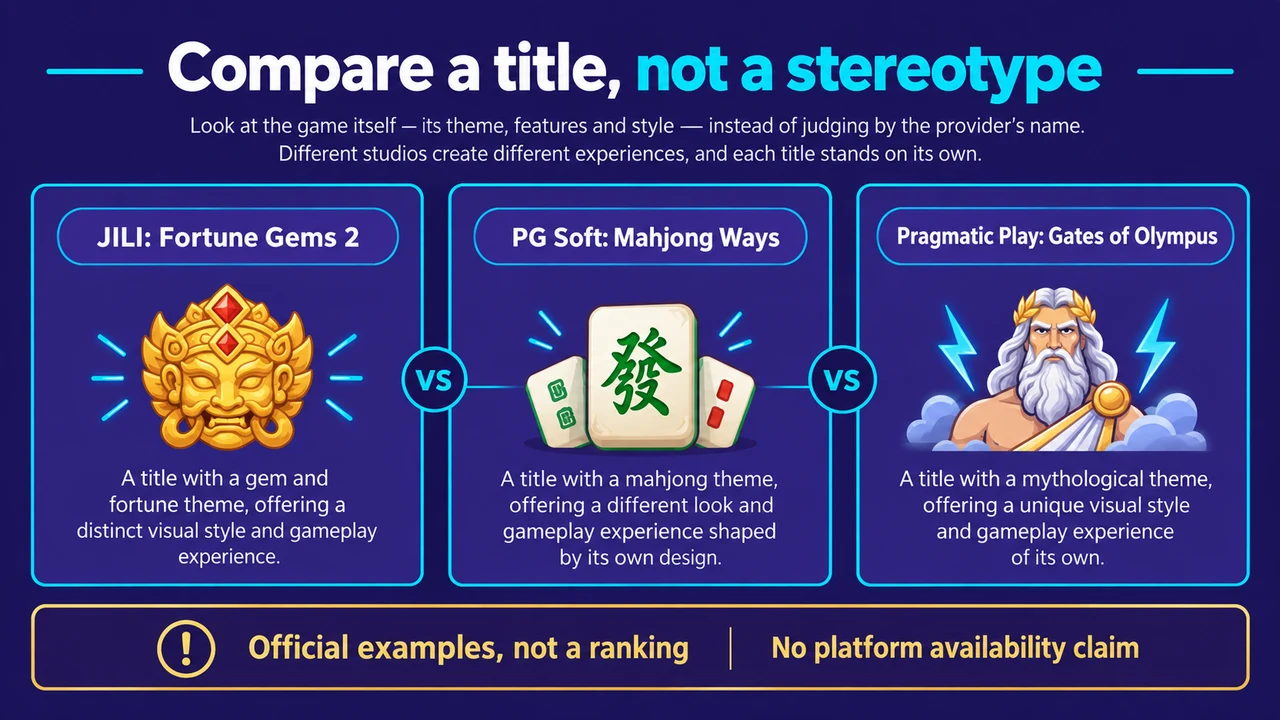
Three source-backed examples show why the comparison unit should be a named game. They are not a shortlist of recommended purchases or a ranking of the providers.
| Provider and example | What the official material establishes | What that does not establish |
|---|---|---|
| JILI — Fortune Gems 2 | Five paylines; Multiplier and Lucky Wheel features listed | All JILI games have the same rules or risk |
| PG Soft — Mahjong Ways | A game-information document explains wins and multiplier progression | Every PG title follows the same progression |
| Pragmatic Play — Gates of Olympus | A dedicated product page for that specific title | The rules of a sequel, another title, or the operator’s version |
JILI’s Fortune Gems 2 product page identifies five lines and named features. PG Soft’s Mahjong Ways game-information PDF describes multiplier progression in its documented game. Pragmatic Play’s Gates of Olympus page establishes a separate named product to investigate. These are starting sources; check the selected game’s own information panel for the version actually offered.
The examples deliberately avoid an average RTP league table. Averaging whatever titles a comparison site happens to include can mix game versions and produce a number that says little about your candidate. A catalogue’s largest advertised multiplier is also a possible outcome under its rules, not an estimate of what a session will return.
Use one set of fields for all three candidates
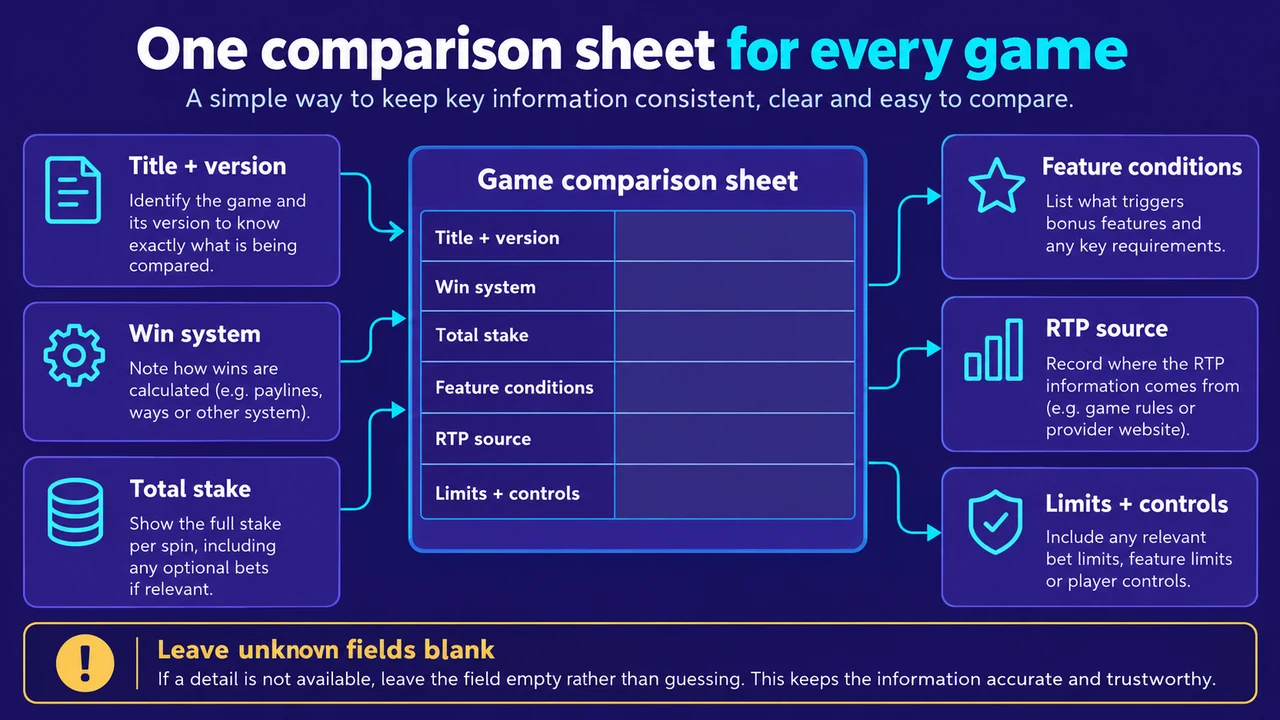
- Exact title and version: distinguish sequels and similarly named games.
- Win system: paylines, ways, clusters or another documented rule.
- Total stake: the amount actually committed to a spin, including optional modes.
- Features: trigger conditions, multipliers and any additional purchase cost.
- RTP information: source, configuration and whether it matches the selected version.
- Limits and controls: maximum-win wording, autoplay settings and a readable exit route.
A blank entry is useful information. If one game exposes a number and another source does not, the missing number cannot be inferred from the provider’s reputation. Keep “not verified” in your notes and compare only the fields supported by sources.
The slot rules-page guide explains where these fields belong. This comparison adds the cross-provider method; it does not reproduce a full rules tutorial for each game. RTP and volatility explains why long-run return information and variation are separate questions.
Features and mobile design are not winning signals
A five-line game may be easier for one reader to explain than a feature-heavy game, while another may prefer the latter’s presentation. That is an interface preference, not evidence of more reliable returns. Likewise, enjoying a theme does not make its bonus appear sooner or its losses less costly.
Device performance should also be compared at the game level. A broad “mobile-first” description is not a measured loading result on your phone. Check whether the rules, total stake and history remain legible on the actual device. Do not wager merely to establish whether a menu is readable, and do not treat a short demo as an earnings test.
A fair comparison holds the question constant. If one candidate is judged on visual clarity and another on a maximum-win headline, the resulting winner is built into the criteria. Decide which practical field matters to you before looking at the brand, and reject any candidate whose rules or cost remain unclear.
The provider is only one part of the decision
Game provider and casino operator roles explains the boundary: a provider’s product documentation does not verify an operator’s cashier, account support or promotion. Finding a game on an official supplier website also does not prove it is available through Vegas11 in your region.
For a fairness claim, follow the game fairness evidence guide rather than a brand winner badge. Check the actual scope of any test or certification and the operator’s terms separately. No provider name makes gambling free of loss risk.
The conclusion can be “none of these candidates.” If the information is incomplete, the stake is too large for the boundary you set, or the game cannot be used lawfully where you are, stop the selection there. Switching providers is not a remedy for a losing session.
Editorial update: October 2, 2026. Official product material was used to illustrate a comparison method. We have not tested these games, measured load speeds, verified operator listings or established the RTP configuration of a live version. For adults where lawful; the comparison supports understanding, not a promise of returns.
This update was prepared with AI assistance and reviewed separately for clarity and source limits. It does not include a firsthand test of the platform.
Check Vegas11 Details
Review the official sign-in page and current terms, and keep every session within your personal budget and time limits.