

The dealer shows an Ace and offers insurance. You already have ₹1,000 on the hand; accepting adds a separate wager, commonly ₹500. It does not improve your cards. Insurance bets that the dealer has blackjack, and its result must be counted alongside the main hand before you decide what the offer costs.
First read the table’s insurance stake, insurance payout and natural-blackjack payout. The examples below assume insurance costs half the main stake and pays 2:1 profit when the dealer has blackjack. Do not accept an unexplained offer while the timer runs down. If those terms are missing, sit out the side wager.
Two wagers can settle in opposite directions
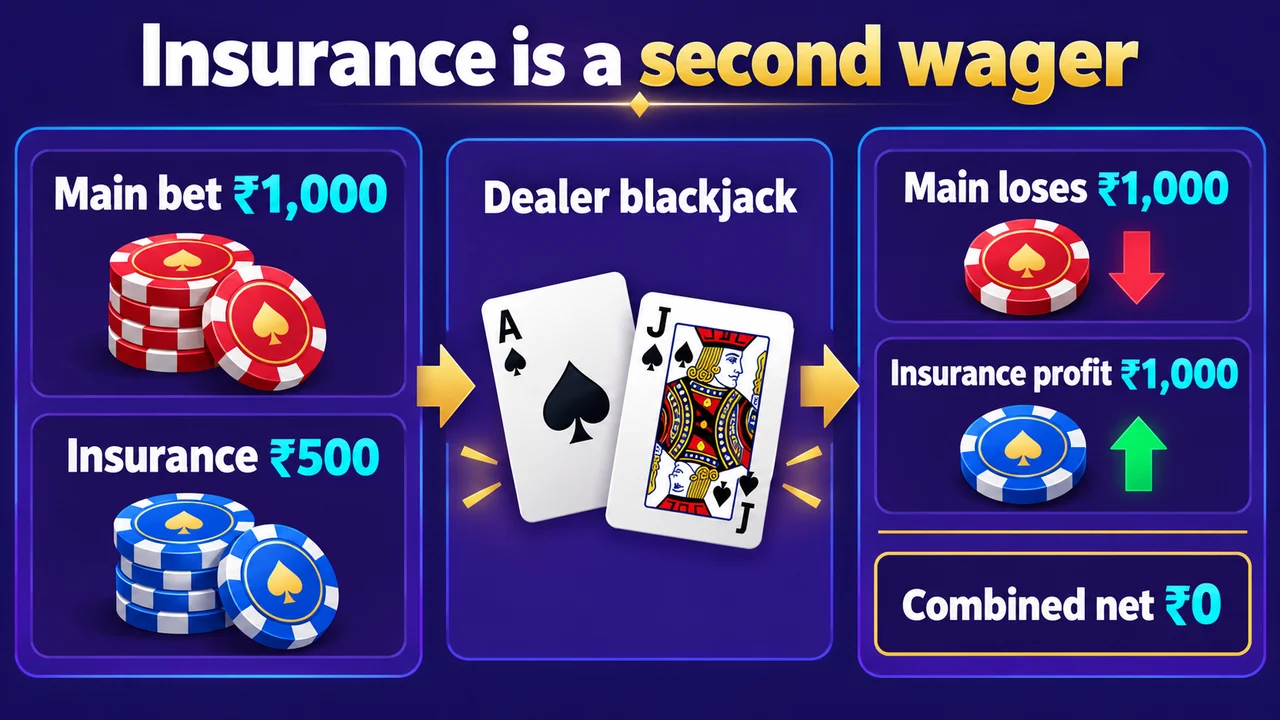
Loto-Québec’s published blackjack rules describe insurance after a dealer Ace: half the original bet, paid at 2:1 if the dealer has blackjack. If the dealer does not, insurance loses and the main hand continues. These are documented game terms, not proof that every live table offers the same option.
Suppose your main hand is not a natural blackjack. With ₹1,000 on the hand and ₹500 insurance, you commit ₹1,500 in total. If the dealer has blackjack, the main stake loses ₹1,000. Insurance returns its ₹500 stake plus ₹1,000 profit. The combined result is ₹0 net: the ₹1,500 credit merely returns the total committed amount.
If the dealer has no blackjack, the ₹500 insurance is lost. Your main ₹1,000 wager remains to be played and can still win, lose or push under the table rules. A later main-hand win does not turn the insurance wager into a winning bet. Record the two results separately.
That separation also matters for other blackjack side bets. Their winning conditions and prices belong to their own paytables. Read each side bet’s own paytable, even when its name is familiar or it appears beside the main wager.
Why even money works with a 3:2 natural payout
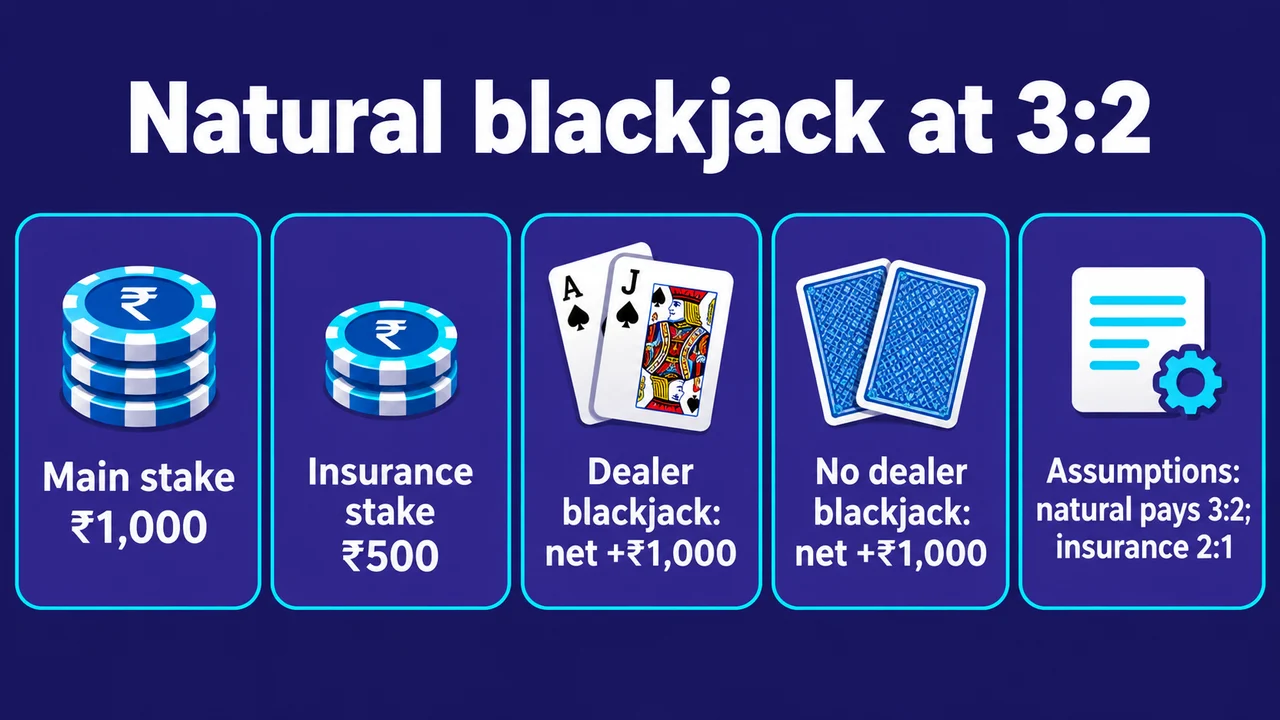
Now assume your first two cards are an Ace and a ten-value card, a natural blackjack, and the table pays naturals at 3:2. The dealer still shows an Ace. With ₹1,000 on your natural, half-stake insurance produces the following combined profit:
| Dealer outcome | Main-hand profit | Insurance profit | Combined profit |
|---|---|---|---|
| Dealer blackjack | ₹0: main wager pushes | +₹1,000 | +₹1,000 |
| No dealer blackjack | +₹1,500 | −₹500 | +₹1,000 |
Under these assumptions, taking that insurance locks in ₹1,000 profit whichever of those dealer outcomes occurs. This is the arithmetic behind a conventional even-money offer. A table may implement even money as a direct settlement or through insurance accounting; check the specific rules rather than assuming the same display sequence.
Declining gives a different pair of outcomes: ₹0 profit if the dealer also has blackjack, or ₹1,500 profit if the dealer does not. Calling the offer “free protection” hides the ₹500 you give up in the second case. It is a choice between different possible returns, not an extra payment added to a full natural payout.
The distinction between a natural and a later total of 21 is explained in the blackjack hand-total guide. The comparison above requires the stated natural-payout rule; it cannot be applied to every hand showing 21.
A 6:5 payout breaks that comparison
On a table paying a natural at 6:5, the same ₹1,000 natural earns ₹1,200 profit when the dealer has no blackjack. Losing ₹500 insurance leaves ₹700 combined profit. If the dealer has blackjack, the natural pushes and winning insurance still earns ₹1,000. Those outcomes differ, so half-stake insurance is no longer equivalent to a flat even-money settlement.
Insurance’s own expected profit also needs a probability assumption. For a ₹500 insurance wager with 2:1 profit, let p be the chance of dealer blackjack at the decision. For this assumed wager, average profit over repeated identical decisions is ₹1,000 × p minus ₹500 × (1 − p), or ₹500 × (3p − 1). It breaks even at p = 1/3. A hypothetical p of 0.30 gives −₹50; that is an illustration, not a measured probability for your shoe.
This guide does not estimate the chance of dealer blackjack from the cards left in your shoe. If an offer would push your total stake beyond your session budget, decline it. Adding a side bet to recover another loss changes the amount at risk without changing the cards already dealt.
Editorial method, October 2, 2026: AI-assisted explanation checked against a named rule document, with original arithmetic under explicit assumptions. No live play or platform availability test was performed. Independent review remains required before publication. Gambling is for adults where lawful and can cause financial loss.
Check Vegas11 Details
Review the official sign-in page and current terms, and keep every session within your personal budget and time limits.