

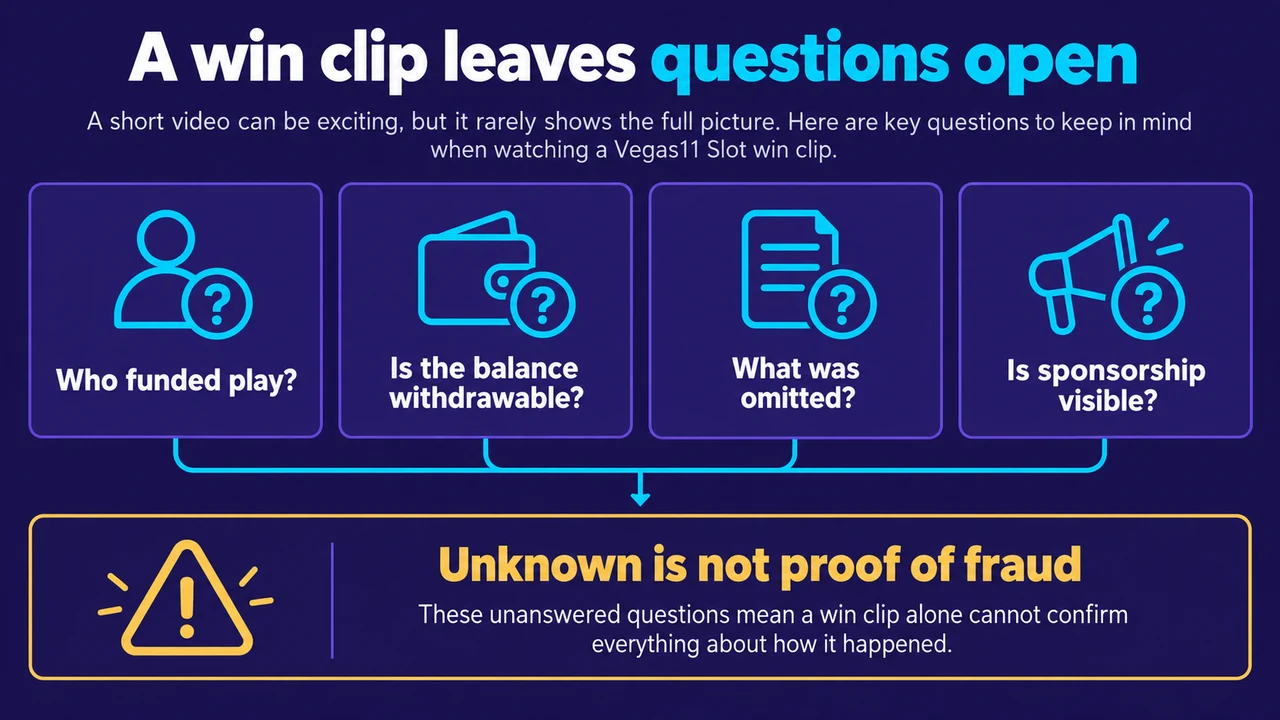
A slot clip shows a huge win, the creator celebrates, and a signup link appears below. You can see the result displayed in that clip. You cannot automatically see who funded the account, which money is withdrawable or what the session cost. Treat those as unanswered questions, and do not make a deposit or copy a stake because the highlight looks convincing.
What is the video actually showing?
Start with the format. A short highlight, a recorded session and a live broadcast offer different amounts of context. A highlight can show a real event while leaving out hours of losing play. A live stream gives more continuity, but being live does not disclose the account’s funding agreement or remove the possibility of omitted information.
That is a limit on the evidence, not an accusation against the creator. We do not have a reliable basis for saying most streamers use fake funds, that genuine creators are rare, or that any particular person is dishonest. The useful question is narrower: what conclusion can this video support, and what remains unknown?
Look for the commercial relationship where you are watching
A creator may earn advertising revenue, receive a sponsorship or be paid through an affiliate arrangement. A visible signup code is a reason to look for an explanation of that relationship. It is not, on its own, proof that the displayed balance is imaginary or that the game result has been altered.
The US Federal Trade Commission’s influencer disclosure guidance calls for material connections to be clearly disclosed with the endorsement; it also discusses repeating disclosure in live streams so later viewers see it. We use that as a transparency reference, not a legal ruling about every India-facing creator. Look for ordinary wording explaining payment, free benefits or an affiliate relationship, rather than assuming a profile badge answers the question.
A disclosure hidden in a channel biography is easy to miss if you arrive through a shared clip. So is an announcement made before you joined the broadcast. If the relationship is not explained in the content you can see, leave it unresolved. A clear sponsorship label is useful, but it still does not tell you the conditions attached to the balance.
A balance has a funding story
| Context | What it may explain | What remains to verify |
|---|---|---|
| Creator says personal funds | The stated source of the stake | Actual costs and any reimbursement. |
| Sponsored or credited funds | A commercial benefit supports play | Withdrawal restrictions and risk borne. |
| Demo or simulation | The display is for demonstration | No personal cash profit follows from the screen. |
| Funding not disclosed | Information is incomplete | Do not guess real or fake. |
The distinction between demo and real-money play matters here. A numerical balance alone does not tell you the mode or contractual conditions. Equally, showing a loss does not prove the creator paid for it personally. A reimbursement or credit arrangement can change who bears the financial loss without changing the event visible to the audience.
Viewers do not need a creator’s full bank statement, identity document or private account history. Ask for an explanation of the funding type and restrictions, with sensitive details kept private. A refusal or incomplete answer means the funding context remains unknown; it does not justify an allegation of fraud.
Separate a payout from a profitable session
A clip can show a large award after one paid spin while the whole session remains down. To assess the session, you would need the relevant start and end points, stakes and returns, plus any deposits, withdrawals or promotional credits that change the balance. Even a clearly profitable session gives no probability estimate for your own next attempt.
Watch for editing that changes what a claimed outcome means: a reset balance, an unlabelled jump in time, a different stake or a cut between a feature purchase and its result. These are prompts to ask for context. They are not reliable proof of an invented event, and they should not be used to label a named creator dishonest.
Keep the stream out of your spending decision
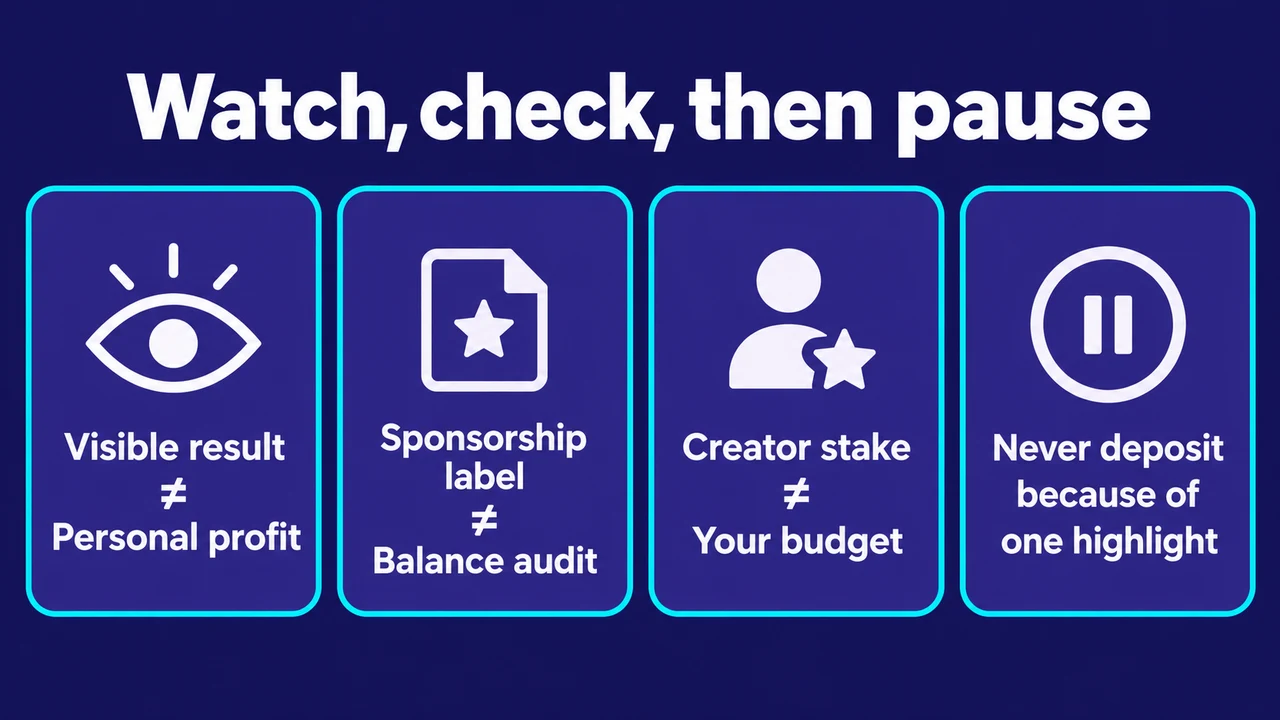
Use the casino review methodology if a promotion prompts you to examine an operator. Check current terms and evidence directly. This article has not verified a Vegas11 influencer agreement, affiliate policy, personal-funds requirement or payout promise, and it does not endorse an operator because a streamer mentions it.
For any optional participation, your own money and time limits must exist before the video creates urgency. A creator’s stake may be financed under conditions you do not share. Scaling it to your balance does not turn it into a strategy or evidence of better odds. If watching makes you want to recover losses or spend unplanned money, close the stream and pause.
Streaming platforms have their own rules. Twitch’s branded-content policy describes disclosure tools and restrictions on risky gambling promotions; check the current policy rather than treating the continued presence of a broadcast as approval of its operator. A platform label and a sponsorship disclosure answer different questions.
Source and update note
Updated October 2, 2026. Vegas11 editorial media-literacy guidance based on the FTC and Twitch material linked above. No creator account, sponsor contract or private balance was audited. Earlier unsupported claims about fake-stream prevalence and Vegas11 partnerships have been removed. For adult readers; a stream does not establish local gambling eligibility or a financial opportunity.
This update was prepared with AI assistance and reviewed separately for clarity and source limits. It does not include a firsthand test of the platform.
Check Vegas11 Details
Review the official sign-in page and current terms, and keep every session within your personal budget and time limits.