

Your Banker bet comes back after equal hand totals, but the screen also says “Tie wins.” Both can be correct. Under standard commission-baccarat rules, a tied hand pushes the Banker and Player wagers while paying anyone who actually placed a separate Tie wager. You do not receive Tie winnings merely because your main bet was returned.
Check the wager names in the round record before comparing the balance. A push means that the particular wager returns its stake without profit under the stated rule. If a fee, side wager or settlement label is unexplained, pause new wagers until the current entries can be matched. The same word can have a different financial effect in another baccarat variant.
A round result and a wager result are different records
The round result tells you whether Banker won, Player won or the final totals tied. The wager result answers what happened to the money on a specific betting spot. One tied round can therefore contain a refunded Banker wager and a winning Tie wager. Keep each spot separate instead of treating the entire screen as one win or loss.
Loto-Québec’s published standard baccarat rules document that distinction: equal totals settle Tie as a win and the main Banker and Player wagers as pushes. Their paytable lists Tie at 8:1. Another table may quote 9:1 or use different rules; the actual paytable controls the example you should use.
Follow ₹1,000 on Banker and ₹100 on Tie
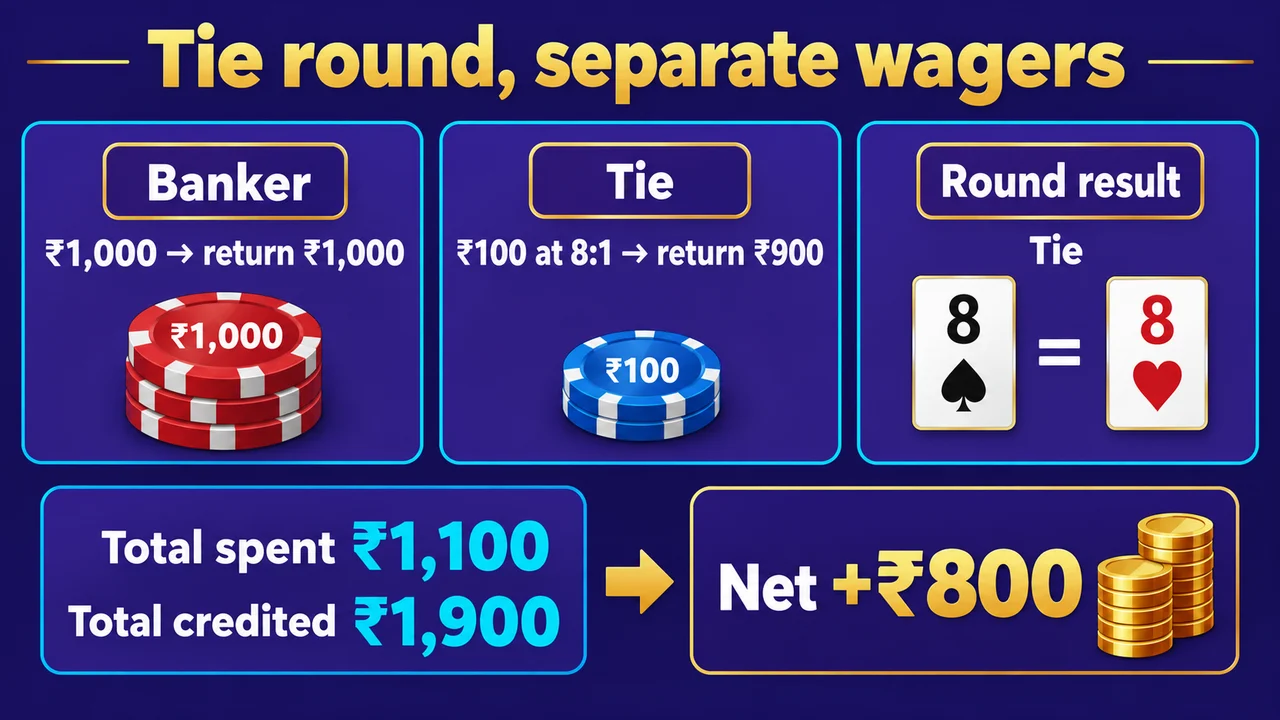
Assume a standard table paying Banker at 0.95:1 and Tie at 8:1, with main bets pushed on a tie, no extra fee and no rounding. The total committed is ₹1,100. These are teaching amounts, not a recommended staking combination or a prediction of how often either result occurs.
| Round result | Banker return | Tie return | Total credited | Net result |
|---|---|---|---|---|
| Equal totals | ₹1,000 | ₹900 | ₹1,900 | +₹800 |
| Banker wins | ₹1,950 | ₹0 | ₹1,950 | +₹850 |
| Player wins | ₹0 | ₹0 | ₹0 | −₹1,100 |
On the tied hand, the ₹100 Tie stake earns ₹800 profit and comes back with it, producing ₹900. The main stake returns separately. Subtract the ₹1,100 you staked from the ₹1,900 credited: the profit is ₹800. At a 9:1 Tie paytable, that same hypothetical tied round would instead credit ₹2,000 and produce ₹900 net profit.
If only ₹1,000 had been placed on Banker, the tied hand would return ₹1,000 with zero profit. No separate Tie wager means no 8:1 award. Conversely, a Tie wager normally loses when one hand wins outright, even if that winning hand also pays your main bet.
Why “push” does not always mean a cost-free round
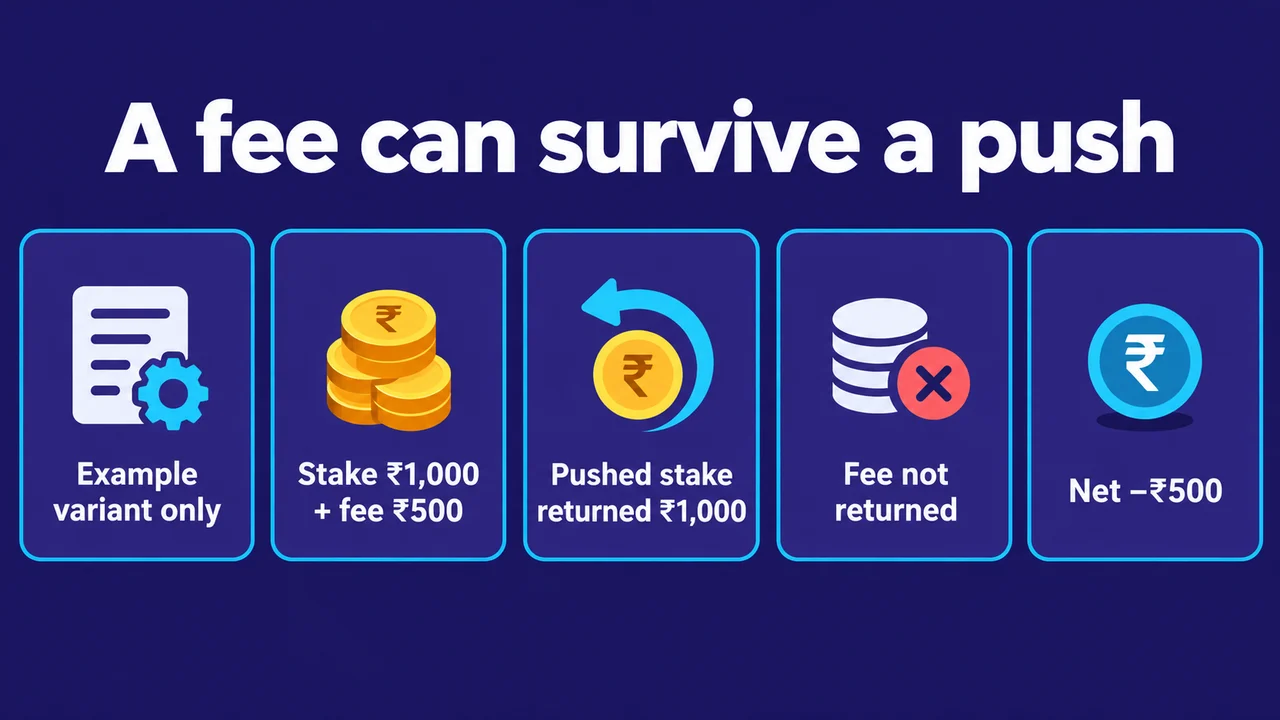
Commission and entry fees are different charges. A standard winning-Banker commission is not charged simply because a main wager pushed. But the XXXtreme Lightning Baccarat rules published by Loto-Québec give a named exception: they add a 50% fee and do not return that fee on pushed Player or Banker wagers.
Using only that documented fee structure as an illustration, a ₹1,000 main stake plus ₹500 fee commits ₹1,500. If the main wager pushes and only its ₹1,000 stake returns, the net result is −₹500. The word “push” described the wager, not reimbursement of every associated cost. This does not claim that Vegas 11 offers that game or uses that fee.
Banker commission and variant settlement explains the payment-format differences. A variant-specific push can also occur without a tied hand: EZ Baccarat’s rule pushes the Banker wager on a winning three-card Banker 7. Banker won that hand; the push comes from the variant’s exception, not equal hand totals.
Read the final totals, then the transaction lines
If you are unsure whether the round actually tied, check the final hand totals after any required third cards, rather than the first two cards or a colour on a road. The third-card rule guide addresses that dealing step. A scoreboard is not a substitute for the wager history when reconciling money.
- Identify the exact table and rule version.
- List each accepted wager and any separate fee.
- Match each return to the same round reference.
- Subtract all committed amounts from all credits to find the net result.
- Ask about a specific unmatched entry rather than assuming Tie and push are interchangeable.
For the broader boundaries before joining a table, use the baccarat rules-and-limits overview. Adding a Tie wager increases committed money and does not guarantee that a session is protected.
Editorial method, October 2, 2026: prepared with AI assistance from the linked rule documents and original arithmetic. Independent copy and source review is required before publication; no live wagering, refund test or operator listing check is claimed. This explanation is for adults where gambling is lawful, and no settlement example removes financial loss risk.
Check Vegas11 Details
Review the official sign-in page and current terms, and keep every session within your personal budget and time limits.