

Two symbols show 2× and 3× beside a ₹10 award. Depending on the stated rule, they could produce ₹50, ₹60 or apply to separate amounts. Do not multiply every number visible on the screen. Find what qualifies and how the values combine; if the rule and settled award do not reconcile, pause the next wager and keep the round reference.
The same symbols can describe different calculations
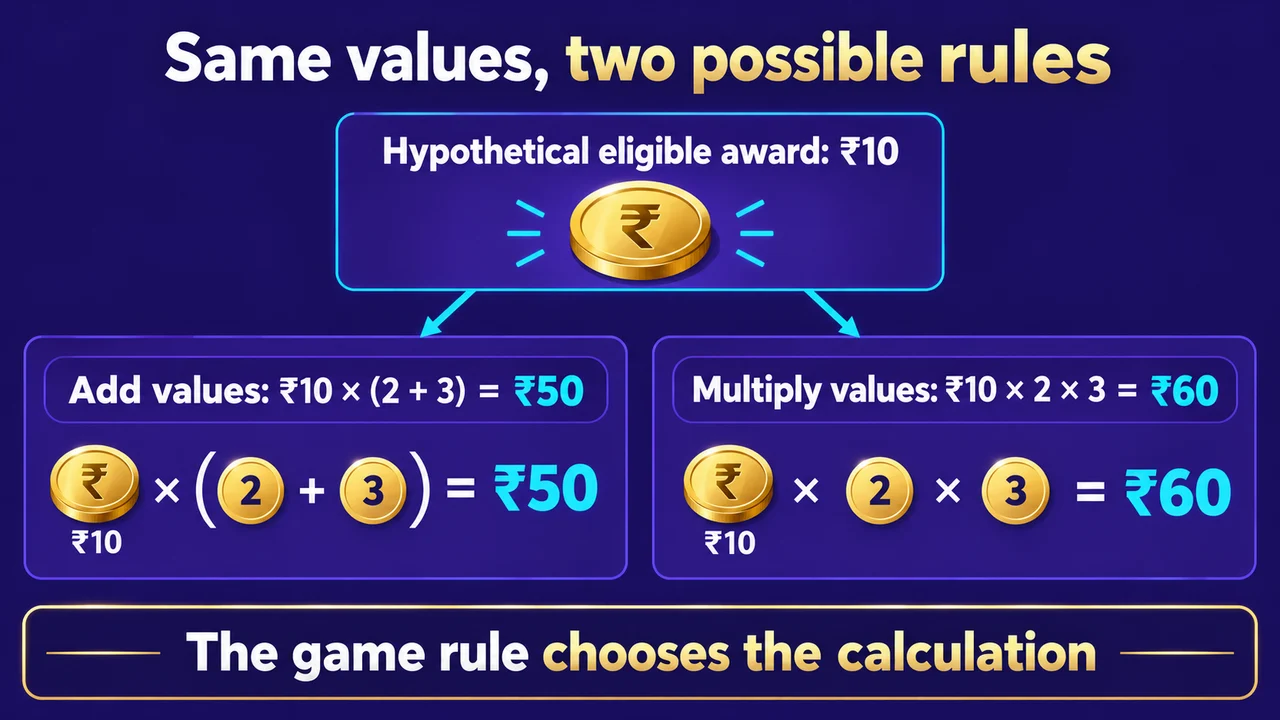
First find the award before the multiplier is applied. It might be the award from one line, a particular symbol, a cascade subtotal or a complete feature. That starting amount is not necessarily the stake or every win collected during the round. Next find the rule that tells you what to do with the multiplier values.
The following examples assume an eligible award of ₹10 with visible 2× and 3× values. They illustrate two invented rules. Neither calculation establishes what a JILI, PG Soft or other title does, and neither contains a probability of receiving that award.
| Hypothetical stated rule | Calculation | Modified award |
|---|---|---|
| Add the multiplier values | ₹10 × (2 + 3) | ₹50 |
| Multiply the multiplier values | ₹10 × 2 × 3 | ₹60 |
Adding the values first produces a 5× modifier. Multiplying them produces a 6× modifier. The difference comes from the rule, not from which symbol feels luckier. If the information says “added together,” treating the values as successive multipliers would overstate this hypothetical award.
Which part of the result qualifies?
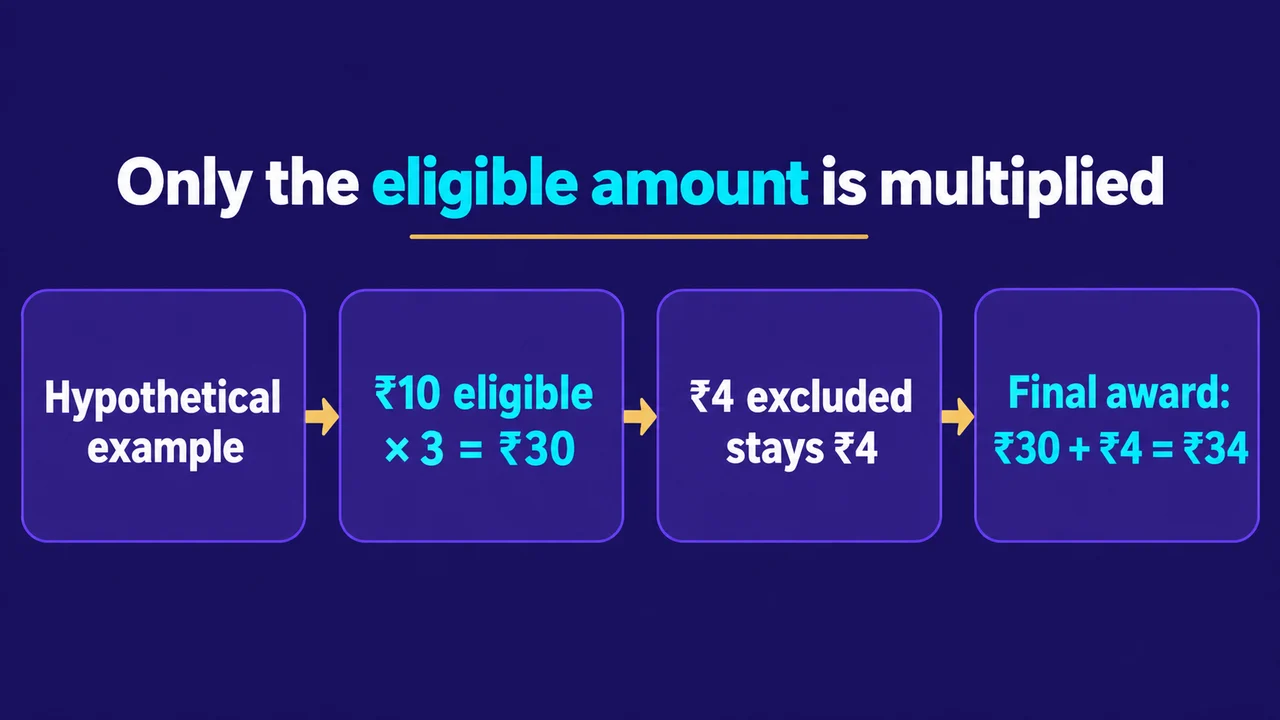
Now imagine an event with two separate awards: ₹10 that qualifies for a 3× modifier and ₹4 that does not. The correct calculation under that invented rule is (₹10 × 3) + ₹4 = ₹34. Multiplying the entire ₹14 subtotal gives ₹42, but that would apply the modifier to money the rule excluded.
A paytable can specify which symbols or combinations qualify and which do not. Use the paytable-reading guide to locate that wording, then keep the qualifying amount separate. A multiplier on one reel or one symbol is not automatically a multiplier for every award elsewhere on the screen.
Be careful with a displayed total that already includes a modifier. If “win” is the completed adjusted award, multiplying it again would double-count the feature effect. A breakdown with base award and final award is more useful than trying to infer the calculation from the size of an animation.
Feature stages can change what a value means
A modifier can belong to a particular stage under the game’s rules. Read when it is applied, when it increases and when it resets. A value carried into the next stage may already include earlier multipliers. Check what it contains before multiplying again. Two visible labels can therefore be describing different stages of the same calculation.
An accessible first-party example is the Slot Vegas Fully Loaded help document, which separately describes symbol multipliers and a free-spin multiplier starting from a combined symbol total. That supports checking the stage and scope, not borrowing its rule for another game. This page does not establish current availability of that title or a matching build on Vegas11.
For the removal-and-drop sequence itself, see the cascading-reels explanation. Here the task is narrower: reconstruct the award inside the sequence. Do not add each cascade’s award to a cumulative final total unless the rules show those are distinct amounts.
“Order” means the game procedure, not a maths trick
Multiplying the same eligible amount by 2 and then 3 gives the same result as multiplying by 3 and then 2. Reversing simple factors is not a hidden payout strategy. The result can change when a rule changes which awards qualify, adds rather than multiplies the values, caps the award or resets the counter.
Read the maximum-win explanation separately if the reconstructed amount reaches a stated ceiling. Do not presume whether a cap applies per component, paid event or full feature. That boundary also has to come from the current rules.
Explain the discrepancy before repeating the action
A useful question for support identifies the title, round reference, eligible pre-modifier amount, visible values and rule wording. Describe the calculation you expected and the settled amount you saw. Remove private account details from any screenshot. You do not need another paid round to make the question more precise.
The UK Gambling Commission’s game-information standard is a scoped reference for understandable rules and payout information. It does not verify this website’s compliance. If the relevant wording is absent, leave the calculation unresolved and the next wager unplaced rather than inventing a rule from a comparison video.
Sources and calculation limits
Checked October 2, 2026. Prepared with AI assistance for Vegas11 editorial use. The equations are explicitly hypothetical and are not observations, provider payout data or a method to improve winning chances. The first-party help document and regulatory reference above were used to check the limits of the explanation. No same-version live game was tested; participation is only for legally eligible adults.
Check Vegas11 Details
Review the official sign-in page and current terms, and keep every session within your personal budget and time limits.