

A slot has awarded ₹100 and now offers “Collect” or “Gamble.” The gamble button is a fresh risk to the amount already awarded, not a free attempt with money that no longer matters. Read exactly how much can be lost and what each option does. If that risk or the collection route is unclear, do not enter the optional gamble.
The ₹100 is the starting point for this decision
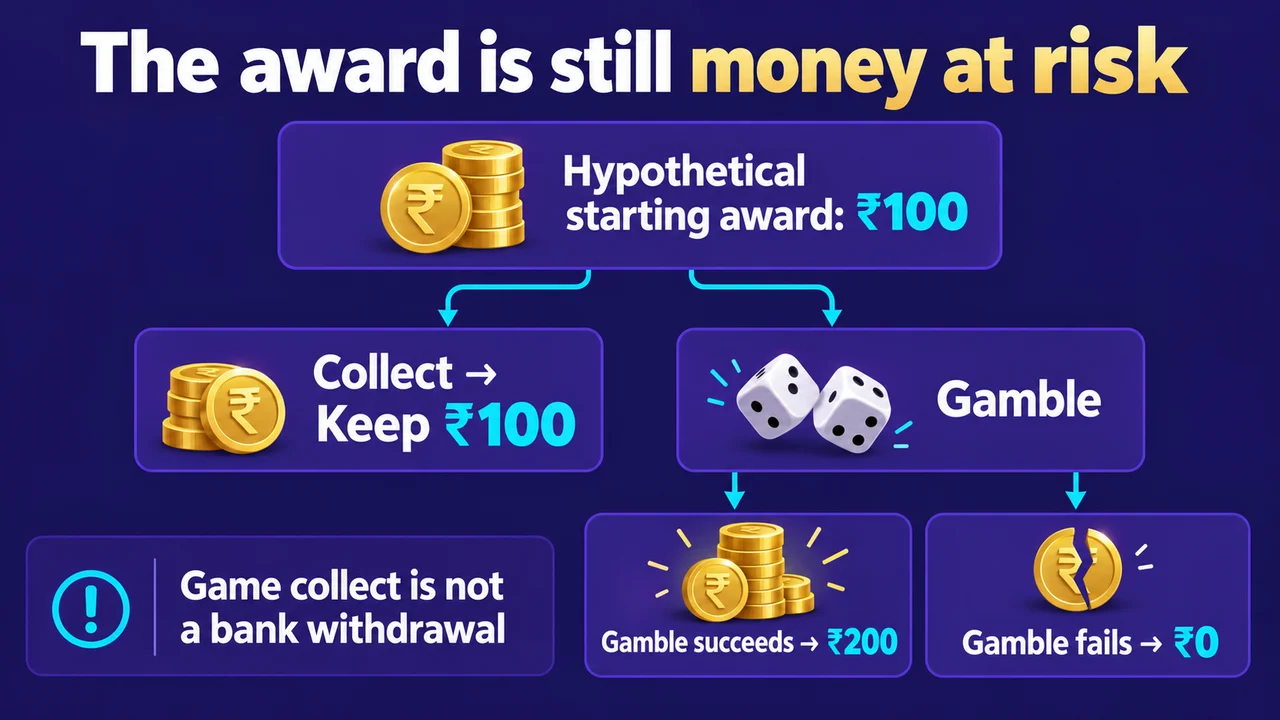
Suppose a hypothetical game offers a simple double-or-nothing choice after awarding ₹100. Collect retains that award in the game or account under the rules. A successful gamble returns ₹200; a failed gamble returns nothing from the amount risked. The original paid spin and its stake have already happened, so compare these new choices from the same ₹100 starting point.
| Choice or outcome | Amount retained from this award | Difference from collecting |
|---|---|---|
| Collect | ₹100 | ₹0 |
| Gamble succeeds | ₹200 | +₹100 |
| Gamble fails | ₹0 | −₹100 |
These are invented teaching rules. An actual feature may risk only part of an award, offer several multipliers or impose different limits. Do not assume the button label guarantees the table’s outcomes. In this example, you could have kept the award by collecting. A failed gamble gives up that amount.
Collect is not the cashier
In a game interface, collect commonly means ending the optional risk and settling an award as its rules describe. It is not automatically a withdrawal request to your bank account. Cashier eligibility, identity checks, bonus conditions and payment instructions are separate operator matters.
Read the game rules-page guide for the action inside the title. If the label or route differs from this general explanation, follow the current wording. Do not assume that closing a window, running out a timer or losing your connection has the same effect as pressing collect; interruption handling needs its own applicable rule.
Promotional accounting is another separate question. Our game-contribution guide explains how eligible turnover is counted. It does not establish whether a gamble attempt is allowed or contributes under your promotion. Check the active terms before committing, rather than using the optional feature to try to clear a requirement faster.
Repetition changes the amount exposed
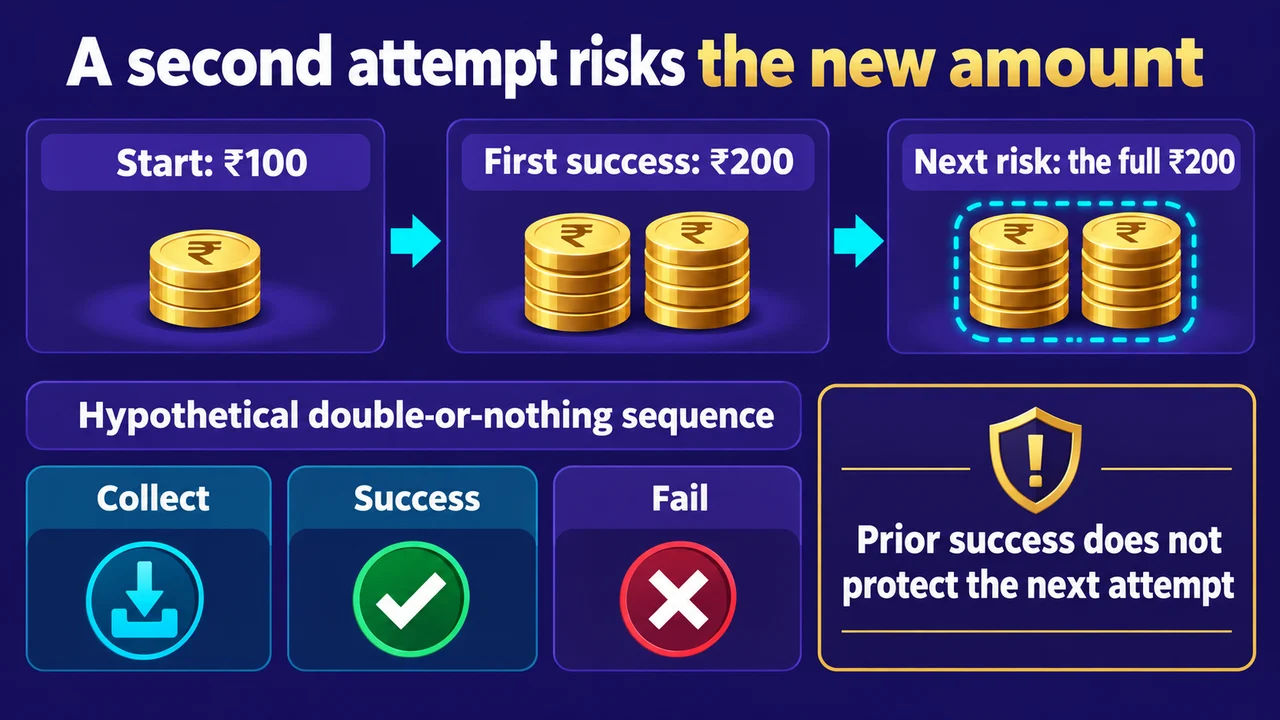
For a pure mathematical illustration, assume each choice is independent, has a one-half chance of success, risks the entire current award and pays exactly double after success. Two consecutive successes would turn ₹100 into ₹400. Their probability under those invented assumptions is one-half × one-half = one-quarter. Any failed choice ends this all-or-nothing sequence with zero.
That illustration is not a published probability for any real slot. Under this assumed model, only one in four two-attempt sequences keeps the award and reaches ₹400; the other three end at zero. After the first success, the second attempt exposes ₹200, not only the original ₹100. A prior successful guess cannot make the next independent choice safer.
Do not generalise a red-or-black illustration to every card feature. Jokers, suits, special outcomes and payout rules can change the possible events. If the actual game does not state the relevant probabilities, leave them unknown rather than declaring its gamble a fair 50/50 choice.
What a real source can establish
GameArt’s official 40 Super Blazing Sevens page describes an optional card gamble with distinct multiplier choices and a repeat limit. It demonstrates that a provider can state feature conditions explicitly. It does not prove that all gamble games share them, that the title is offered on Vegas11, or that the deployed version matches that page.
The technical standard GLI-11 version 3.0, section 4.11 calls for choice, accessible instructions and disclosed limits in its gaming-device scope. It is a reference for questions to ask, not proof of this platform’s certification. One game’s feature description does not tell you what another game offers or what your session will return.
An award does not expand your budget
Treat the amount you could collect with the same care as money you brought into the session. “It is only winnings” does not make the loss irrelevant. Decide any money and time boundary before the offer appears, rather than adjusting it after a successful attempt.
Use a session budget plan that covers optional risks as well as ordinary paid spins. If you are considering another attempt to replace a previous loss, leave the gamble sequence. You do not have to reach a repeat limit, a target multiplier or a promotional goal to end the session.
Editorial method and source limits
Checked October 2, 2026. This AI-assisted Vegas11 explanation uses the linked first-party feature description, a scoped technical standard and expressly hypothetical calculations. It includes no private account review, live gamble test or prediction of a reader’s results. Read the exact version’s rules and participate only if you are an adult legally eligible where you are.
Check Vegas11 Details
Review the official sign-in page and current terms, and keep every session within your personal budget and time limits.