

Quick answer: Ordinary account closure and formal self-exclusion are not necessarily the same. Closure may end access to one account, while self-exclusion is a stronger responsible-use request with its own duration, scope, marketing and funds rules. Read the current operator and local guidance before acting.
By Vegas11 Editorial Team – Updated 2026-09-19 – For adults of legal gambling age only.
Editorial view: The decision should be based on the level of boundary needed, not on which button sounds easier. A clear record of the chosen route protects the reader from later confusion.
How to Apply This Check
Use this guide as a short decision routine for account closure and self-exclusion, not as a promise about what a platform, game, payment provider or support team will do next. Begin with the exact screen, rule or message in front of you. Write down the wording before changing settings or repeating an action, because small differences in status labels can change the correct next step.
Next, separate facts from assumptions. A fact is a timestamp, visible status, published rule, transaction reference or support reply. An assumption is a guess that a payment failed, a feature is due, a limit has already applied or another party must be responsible. Keeping those categories apart makes the situation easier to explain and reduces avoidable repeat attempts.
Then compare the information with your own boundary. For a game topic, that means checking the planned stake, time and stop point. For an account or payment topic, it means deciding what information you are comfortable sharing and using only the official recovery or support route. If the details do not match, pause instead of forcing the next action.
A useful record does not need to be complicated. Save the relevant page or message, note the date and time, identify the system that showed the status, and write one clear question for the next reviewer. Do not include a password, one-time code, full payment credentials or unnecessary identity documents in a message or screenshot.
Finally, re-check the current terms before relying on an older explanation. Operators, providers and markets can change labels, limits, eligibility conditions and support routes. This article gives you a way to read the information; the current official page remains the controlling source for the action you take.
What This Guide Does Not Establish
A checklist can improve the quality of a decision without predicting the outcome. It cannot turn a long-run statistic into a short-term expectation, make a pending status resolve faster, override a verification requirement or establish that a particular complaint will be accepted.
If the situation involves a safety boundary, account access, money movement or a responsible-use tool, choose the more conservative step when the facts are unclear. Stop, use the official support channel and keep the record needed for a precise answer. That is usually more useful than relying on a forum comment, a copied screenshot or a confident claim without a source.
What to Check First
- Name the boundary you need.
- Read closure and self-exclusion terms.
- Ask about funds and records.
- Save confirmation and case numbers.
| Area | Ordinary closure | Self-exclusion |
|---|---|---|
| Purpose | End or pause an account service | Support a formal stop to gambling |
| Duration | Operator process | Defined period or rule |
| Marketing | Ask what is removed | Often includes marketing removal |
| Reactivation | May have a standard route | May be restricted or delayed |
| Support | Account service | Responsible-use support |
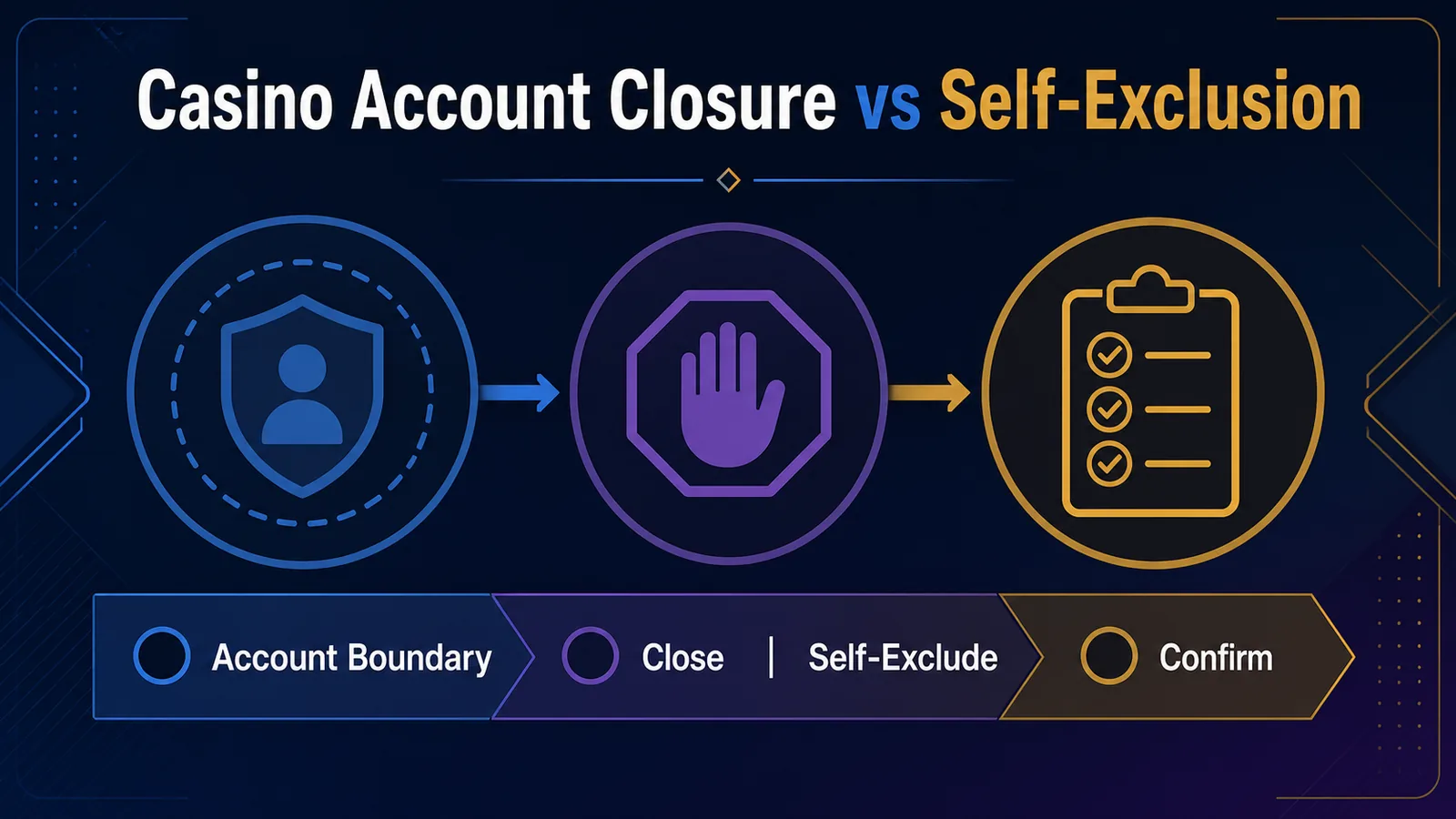
Ordinary closure
An ordinary closure request may be used when a reader no longer wants the account, is changing platforms or needs a standard account-service action. The platform may explain what happens to balances, records and reactivation.
Closure does not automatically mean that all gambling access or marketing is covered. Ask what the request includes and keep the confirmation.
Formal self-exclusion
Self-exclusion is intended for a person who wants support to stop gambling. It may close the account, remove marketing and apply a period during which the operator should take reasonable steps to prevent play.
Read the duration, scope and reactivation conditions carefully. If several operators or a multi-operator scheme are relevant, confirm the exact coverage.
Funds and records
Before submitting a request, ask how pending withdrawals, deposits, identity checks, transaction records and support cases will be handled. The current terms and applicable rules control the details.
Do not keep depositing or playing while waiting for an answer. Save the request time, confirmation and any instructions about remaining funds.
Choose support over guessing
If the reason for closure is that gambling is becoming difficult to control, use responsible-use support rather than treating closure as a technical reset.
A stronger boundary and outside support can be appropriate. The article’s job is to make that step clear, not to persuade a reader to keep an account open.
| Question | Record |
|---|---|
| Which route am I choosing? | Exact request name |
| What happens to funds? | Official instruction |
| What happens to records? | Confirmation or ticket |
| What is the duration? | Start and end rule |
| Where can I get help? | Support contact |
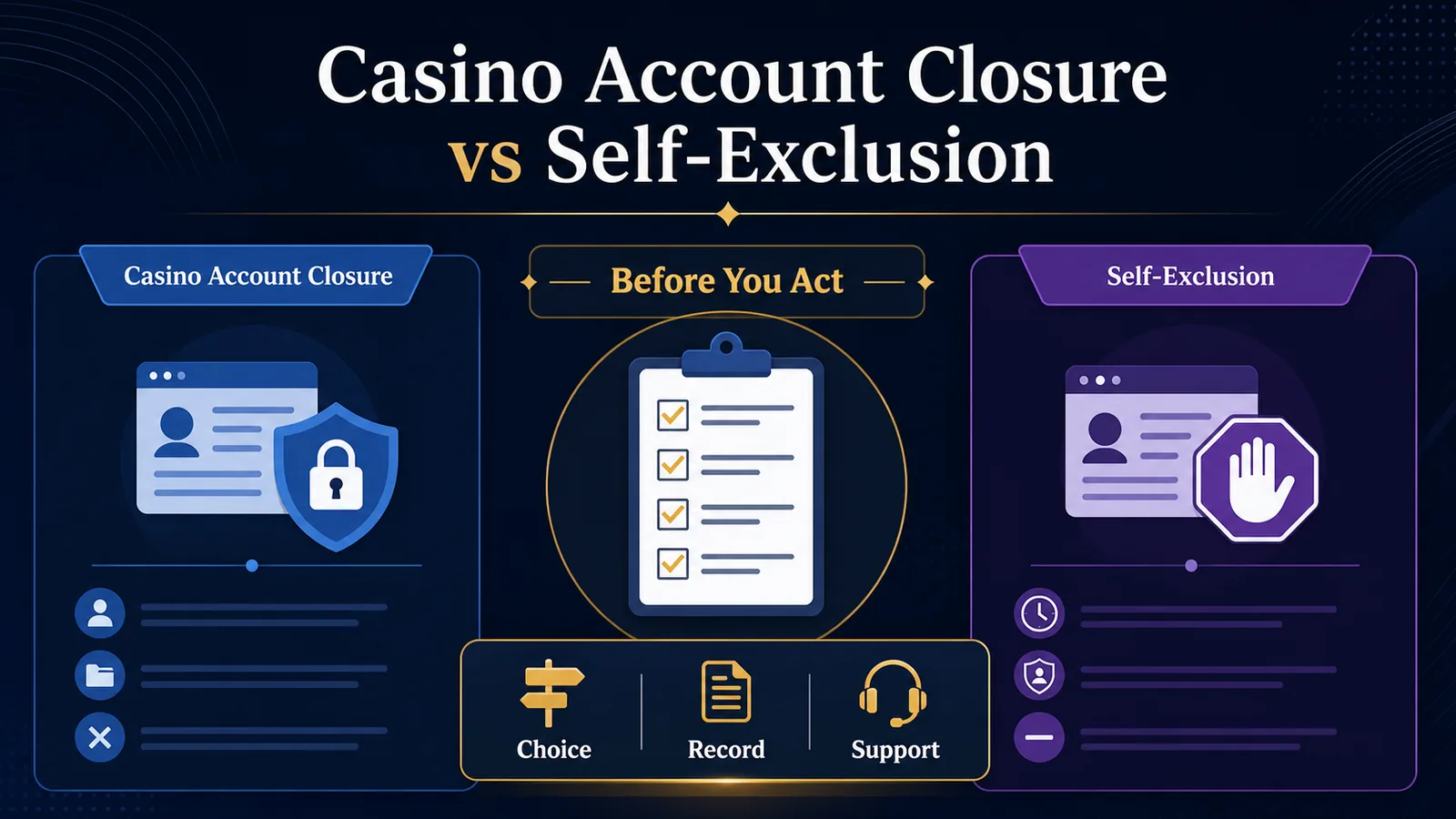
Practical Checklist
- Name the boundary you need.
- Read closure and self-exclusion terms.
- Ask about funds and records.
- Save confirmation and case numbers.
- Use outside support when needed.
Frequently Asked Questions
Is closing an account the same as self-exclusion?
Not necessarily. The purpose, duration and scope can differ.
Can I reopen a closed account?
That depends on the operator’s current rules; a self-exclusion period may have stronger restrictions.
What if I want to stop gambling completely?
Read formal self-exclusion options and seek responsible-use support rather than relying on an ordinary closure alone.
Sources and Limits
This article is educational and does not promise a result, payout, approval or account outcome. Rules, payment instructions, responsible-use tools and promotions can vary by provider, operator, market and date. Check the current official page before joining, depositing, playing or requesting a withdrawal.
- UK Gambling Commission: self-exclusion
Related Reading
- Responsible Gaming Tools: Limits, Breaks and Self-Control Basics
- Responsible Slot Play: Budget and Session Limits
- Casino Account Safety Checklist for New Players
A Clear Next Step
Source and Update Note
Last updated: September 6, 2026. Edited by the Vegas11 content team. This guide is maintained from Vegas11’s own information pages and is written to answer the search task above. Check the current on-screen rules, payment status or operator terms before acting; no article can guarantee a payout, approval, timing or result.
Related Vegas11 references: Responsible Gaming Tools: Limits, Breaks and Self-Control Basics · Responsible Slot Play: Budget and Session Limits · Casino Account Safety Checklist for New Players
Check Vegas11 Details
Review the official sign-in page and current terms, and keep every session within your personal budget and time limits.